WSU Puget Sound Extension Forestry E-Newsletter – Winter 2026
Download a print-friendly PDF in standard print
Download a print-friendly PDF in large print
Editor’s note
This newsletter has been on hiatus for the past three years and was replaced with simple program announcements. In 2026, we are returning to the format of a full newsletter. For those of you who subscribed prior to 2023, you will notice the return of familiar features like Forester’s Notes et al. in addition to numerous program announcements, including our 2026 winter school that is less than a week away (still plenty of time to register!).
In this issue:
Click links to jump to article
- Forester’s Notes
- Program updates
- 2026 Puget Sound Area Forest Owners Winter School – February 21st
- 2026 Southwest WA Forest Owners Winter School – March 21st
- Spring 2026 Forest Stewardship Coached Planning courses
- Friday Harbor
- Encumclaw
- Stanwood/Camano
- Skykomish
- Spring 2026 Birds in Your Forest workshop
- Other educational opportunities
- Tidbits
- Market update
- Focus on: native trees and shrubs for wet sites in western Washington
- Subscription and Contact Info
Forester’s Notes
The importance of goals
Another new year has arrived. Embarking on the next spin around the sun affords us a chance to reflect on where we have been and what awaits. Thus, the beginning of the year finds many of us making and updating goals for the months ahead. I have never made new year’s resolutions, but I have picked up the practice of writing down personal and professional goals, as research has shown that written goals are more likely to be achieved.
Goals and objectives (which have slightly different definitions but for our purposes we use these terms interchangeably) play a big role in forest stewardship. The first section of a forest stewardship plan is reserved for goals and objectives. When people take our stewardship courses, I exhort them to identify and document objectives regardless of whether or not they are writing a forest plan, as this provides necessary context for everything they will learn. Whether or not something is god or bad, relevant or irrelevant depends on objectives.
Rarely can I answer someone’s question without first identifying what the objectives are, since a meaningful answer is fully dependent on this context. My number one answer to questions is, “It depends.” This frustrates the question askers who just want a clear, unequivocal answer about what they should do. Forests and forestry are complex, though, so clear and unequivocal are elusive concepts and at the very least they require a context that consists of objectives and an assessment of current conditions.
As such, I cannot simply tell you what to do, nor should you desire or accept simply being told what to do. The formation of answers and recommendations must include the essential ingredients of context, nuance, variables, uncertainty, alternatives, and tradeoffs. You cannot have meaningful, informed decision making without those elements. There is a risk of decision paralysis with all of this, but that does not need to be the result. It is not about making the perfect decision – it is about making a reasonable and informed decision.
Systems matter
When it comes to my own goals, I usually achieve quite a few in any given year. Invariably, though, there are those that languish on the list, still waiting to be traced across with that magnificent cross-off line that feels so good to draw. I have noticed a pattern in my unmet goals, which is that they tend to be the ones without any specific deadline. These deadline-free goals are not lacking in importance. On the contrary – some of these goals are among my most important. Some are about cultivating relationships, which are vital in both social and ecological contexts. Others are what I refer to as infrastructure projects – developing tools and systems that will enable me to do more things and better things. In his book Atomic Habits, author James Clear argues that these systems are more important than the goals themselves. Goals are difficult to attain without well-functioning systems, and well-functioning systems will tend to accomplish goals as a natural byproduct. This same concept of well-functioning systems applies to forests, which are complex systems – ecosystems that comprise a variety of subsystems. When these systems are compromised, our objectives can also be compromised. When we talk about degraded landscapes, we are talking about landscapes in which ecological systems are not fully functioning. Invasive weeds, invasive pests and pathogens, overstocking, uniformity, mismatched sites and species, fire exclusion, lack of dead wood, and climate change are some examples of things that can inhibit natural systems from functioning properly, which can lead to a failure to achieve desired goals.
Property owners are often unaware of and unwittingly contribute to these system malfunctions. There is a prevailing sentiment that, when it comes to forests, “don’t touch it, you’ll break it,” and “let nature take care of itself.” There is a fallacy in this, though, when the underlying systems and processes that allow nature to take care of itself have been compromised. Another prevailing sentiment is that a healthy forest is a tidy forest, so many people mistakenly believe that they should be out there “cleaning up” dead trees and downed logs, and they degrade habitat and biodiversity systems in the process. These misconceptions are why education programs are so important and why our programs, especially our stewardship course, are so impactful – they allow people to see beyond the trees and holistically understand the system.
Tyrannical urgency
Building and maintaining relationships and systems, whether it involves your work, friends and family, your health, or your forest are prime examples of deadline-free goals that are extremely important but always seem to get overshadowed by something more urgent. Events, deadlines, meetings, phone calls, hundreds of unread emails, illnesses, and suddenly needed repairs are some of the many things that inundate our attention and can keep us fully occupied if we are not careful. Meanwhile, we end up not making time to exercise, not checking in with that friend we meant to call, not writing the book we always wanted to, not traveling to that place we always dreamed of, and letting that patch of blackberries get that much bigger.
Author Charles Hummel addressed this problem in the late 1960s with his book Tyranny of the Urgent. Hummel recognized this tendency for the urgent to overshadow the important such that things that are important but not urgent never get done. Twenty years later, Steven Covey further addressed this issue in his landmark book The 7 Habits of Highly Effective People. Covey illustrates an urgency and importance matrix with four quadrants: urgent and important; non-urgent and important; urgent and unimportant; and non-urgent and unimportant. Covey makes the case that we spend too much time on things that are urgent but unimportant or even non-urgent and unimportant at the expense of that which is important but not urgent.
Waiting for perfection
For me, perfectionism sometimes gets me stuck in something that is not important. I let perfect be the enemy of good. I spend a ridiculous amount of time trying to implement one more little tweak to make something a tiny bit more perfect. I want to be clear that I am not advocating for mediocrity. Rather, I am thinking of tedious minutia that are unlikely to be noticed by or a benefit to anyone and, as such, really do not matter. When these things stop us from getting important work into the done column, opportunities are missed, and positive impacts on our lives and forests are foregone.
Another thing I suffer from is procrastination, as I am sure many of you do as well. For me, this may be related to perfectionism. I want conditions to be perfect before I undertake one of my important but not urgent tasks. I want to get to all those emails awaiting responses and all other urgent matters wrapped up so that they will not distract me and I can be in the perfect frame of mind. Of course, none of us will ever have that clean slate where all urgent matters have been dealt with. Life is a conveyer belt, and there will always be a steady stream of demands on our time. I can end up going months or even years before tackling an important project, waiting for that perfect and inspired frame of mind, when if I had just simply started, wherever I was at, I would be long done and enjoying the fruits of my efforts.
There are also all those tasks that I simply do not want to do. Those tasks may be quite important, but I procrastinate because they are difficult, time-consuming, seemingly unenjoyable, or lacking a clear place to start. Clearing invasives, thinning, planting, filling out cost share applications, reducing wildfire risks, estate planning, and writing a stewardship plan can often feel like that.
Interfering for good
Whether it is due to procrastination, perfectionism, or the ever-present matters of urgency, when we do not attend to the important but non-urgent, we suffer in the long run. We miss important opportunities because we are mired in things that do not really matter. As we are still on the heels of the holiday season, I am reminded of one of my favorite stories, the Dickens classic A Christmas Carol. I finally realized that, as often as I have watched one of the many movie adaptations (I am partial to the one with George C. Scott), I had never read the actual book. Fortunately, my wife gave me said book for Christmas so that I could address that omission. Something that struck me that was in the book but not captured the same way in the movies is when Marley departs and Scrooge looks out to see many other phantoms in misery who had neglected the important things in life. Dickens writes, “The misery with them all was, clearly, that they sought to interfere, for good, in human matters, and had lost the power forever.”
When it comes to forest stewardship, whether it is as a property owner, an educator, a volunteer, or a service provider, interfering for good is what we do. Our work can make significant contributions to an improved natural environment, which in turn improves our lives and the lives of others. We can do a lot of good work in our forests and in other facets of our lives. If we are slaves to the urgent or are perennial procrastinators and perfectionists, though, we may let good work go undone, and ultimately we will all eventually lose that opportunity to interfere.
As we embark into the new year with our goals, we have the daily opportunity to attend to the important but non-urgent things on our lists. We can be deliberate about carving out time in our schedules to pursue these things. We can be deliberate about declining more of the unimportant things that compete for our attention. We do not always have to make other people’s emergencies our own. We can let go of procrastination and perfectionism. Every day we have the opportunity to interfere and do good work. As comedian Mel Brooks said, “Immortality is a by-product of good work.” Our good work lives on. That is our impact and the legacy we leave.
Kevin W. Zobrist
Professor, Extension Forestry
Washington State University
Program updates
Funding cuts are happening at the federal, state, and local level. There are two noticeable impacts on this program going into 2026. The first is that we now have a smaller staff and are doing fewer programs overall. The second is that the program was cut in Skagit County, so we will no longer be doing programs there. This was a decision made by Skagit County government, not the WSU Extension Forestry program. Skagit County residents are welcome to travel to neighboring counties for Extension Forestry programs, and services are still available from other agencies like Skagit Conservation District and the Washington State Department of Natural Resources.
2026 Puget Sound Area Forest Owners Winter School – February 21st
Coming up on Saturday!
Is it time to sharpen the saw of your forestry knowledge? Join us on Saturday, February 21, 2026, at Green River College in Auburn for a full day of learning.
Winter School is the classroom counterpart to our summer field days. Designed to let you attend multiple workshops all on the same day, the Winter School will help you address challenges on your property, restore healthy forest conditions, and achieve your goals. Whether you are a novice to family forestry, or your family has owned land for generations, there is something new for everyone to learn.
You will be able to attend up to six workshops of your choice, out of almost 20 to choose from! In addition, there will be a resource area featuring exhibitors and displays by agencies and organizations that provide services to assist landowners. Winter school is a great chance to network with professionals and fellow landowners.
2026 Puget Sound Winter School topics
This year’s topics include:
- Advanced forest measurements
- Alternate Plans: An Opportunity for Novel Management
- Aquatic Habitats and Riparian Ecology
- Bark Beetles
- Basic Forest Measurements
- Common Root Diseases of Westside Conifers
- Defoliators
- Forest Health Research in the PNW
- Forest Roads: Design and Best Management Practices
- Invasive Forest Weeds
- Native Trees and Shrubs
- Rust Diseases in Washington Forests
- Seedling Selection and Planting
- Shiitake Mushroom Log Production
- Supporting Pollinators in the Forest
- Thinning for Forest Health
- Wildfire Mitigation on the Westside
- Wildlife Habitat Enhancement
- Wildlife Species and Their Habitats
Puget Sound Winter School Details and Registration
Registration fee is $25 per individual or $40 per couple, and pre-registration is required. Registration will NOT be available on site. Registration will close at 5:00 p.m. Thursday, February 19, 2026. Puget Sound Winter School details and registration.
Funding support for this program is provided by King Conservation District and the Washington State Department of Natural Resources. In-kind support is provided by Green River College. Extension programs are available to all without discrimination. Reasonable accommodations will be made for persons with disabilities who contact us in advance of the event.
For questions about this event or to request accommodation, contact Sarah Stewart at sarah.stewart1@wsu.edu or 425-738-0103.
2026 Southwest WA Forest Owners Winter School
Join us March 21st in Vancouver
For those of you farther south, we will be having a similar Winter School on Saturday, March 21, 2026, at WSU Vancouver.
Southwest WA Winter School Details and Registration
Registration fee is $25 per individual or $40 per couple, and pre-registration is required. Registration will NOT be available on site. Registration will close at 5:00 p.m. Thursday, March 19, 2026. Southwest WA Winter School details and registration.
Funding support for this program is provided by the Washington State Department of Natural Resources. Extension programs are available to all without discrimination. Reasonable accommodations will be made for persons with disabilities who contact us in advance of the event.
For questions about this event or to request accommodation, contact Elsa Huan at elsa.haun@wsu.edu or 828-636-0772.
Spring 2026 Forest Stewardship Coached Planning courses
Learn holistic stewardship in our flagship forestry course for property owners
Natural beauty, wildlife, ecosystem health, harvest income, family ties, privacy, and peace and quiet are some of the many reasons people value their forested property. Whatever your values are, this comprehensive, university-based forestry course will help you get the most out of the land you love. Whether you have just a few wooded acres or a larger forest tract, if you have trees on your property, this course is for you.
Topics covered include:
- How do you know if your trees are healthy? What should you do if they aren’t?
- Are characteristics of your property attracting or repelling the wildlife you enjoy? What can you do if wildlife cause damage?
- Are there certain trees you should always keep or remove? How do you cut trees without damaging your land?
- What types of trees do you have? Does your forest look like a “mess”?
- How do you know if your trees need to be thinned, and how do you go about it?
- How do you identify and mitigate wildfire risks?
- Are invasive and noxious weeds taking over your underbrush? What are the risks and what can you do about it?
- What kind of soil do you have and how does that affect what grows?
- How will climate change impact your property and what can you do to improve the resilience of your trees?
- How can you increase biodiversity and foster old growth type forest conditions?
Upcoming courses
- Friday Harbor Coached Planning – Monday afternoons starting March 23rd
- Enumclaw Coached Planning – Wednesday evenings starting April 8th
- Stanwood/Camano Coached Planning – Tuesday mornings starting April 28th
- Skykomish Coached Planning – Thursday afternoons starting April 30th
Spring 2026 Birds in Your Forest workshop
Learn about the birds that call your forest home
Join us from 8:00 a.m. to 12:00 p.m. Saturday, April 18, 2026, in Duvall to learn from experts about some of the birds that call your forest home, what niches they occupy within the forest, what they need to survive, and how you as a landowner, can manage your property to benefit your local feathered friends. This workshop includes a classroom session followed by a bird watching field trip.
The registration fee is $15 per person. Pre-registration is required. Space is very limited! This is a small group workshop, so register early if you want a spot – this will sell out quickly. Registration will open at approximately 12:00 p.m. on Thursday, February 19, 2026. The Birds in Your Forest Workshop Details and Registration.
Additional bird workshop information
Funding support for this program is provided by King County, with in-kind support provided by the Washington State Department of Natural Resources.
For questions, contact Sarah Stewart at sarah.stewart1@wsu.edu or 425-738-0103. Extension programs are available to all without discrimination. Reasonable accommodations will be made for persons with disabilities who contact Sarah Stewart in advance of the workshop.
Other educational opportunities
Non-WSU events are listed for informational purposes with no implied endorsement by WSU.
Estate Planning Seminar for Forest Landowners – Join the Whatcom County Farm Forestry Association for a free seminar at Meridian High School, 194 W Laurel Rd, Bellingham, WA 98226, at 6:00 p.m. Thursday, February 26, 2026.
All About Pollinators Webinar – Join King Conservation District at 6:00 p.m. March 18, 2026, for a free webinar on pollinators. Pre-registration required.
Food Forests: Growing Food and Boosting Forest Health – Join Snohomish Conservation District for a free seminar to learn how to grow more food at home while maintaining a healthy forest. The seminar will be held at the Darrington Library at 11:00 a.m. Saturday, March 21, 2026.
Don’t Feed the Flames: A Landowner’s Guide to Wildfire Resiliency – Join Snohomish Conservation District for a free seminar to learn how to become a wildfire resilient property owner. The seminar will be held at the Darrington Library at 11:00 a.m. Saturday, March 28, 2026.
Two area chapters of the Washington Farm Forestry Association are hosting tree seedling sales:
- Cowlitz Farm Forestry tree sale – Order by February 26, 2026
- Whatcom Farm Forestry tree sale – Order by March 11, 2026
Tidbits
- New Extension publications available:
- The Washington State Department of Natural Resources is conducting Douglas-fir seed source trials to study what seed zones will provide the most productive progeny for different areas of the state under changing climate conditions. If you are interested in getting involved and hosting a trial on your property, contact Stuart Olshevski at the Department of Natural Resources.
- The Washington State Department of Natural Resources has produced a video about the service forestry program. Note – if an advertisement begins playing instead of the service forestry video, refresh the page.
- 2025 Tax Tips for Forest Landowners is now available from the U.S. Forest Service.
- The Snohomish County Noxious Weed Control Board is seeking a volunteer board member to represent District 1, which includes Stanwood, Northern Arlington, Oso, Swede Heaven, and Darrington. If you are interested and you produce agricultural products within this district, visit the Snohomish County Noxious Weed Board Vacancies website for more information.
Market Update
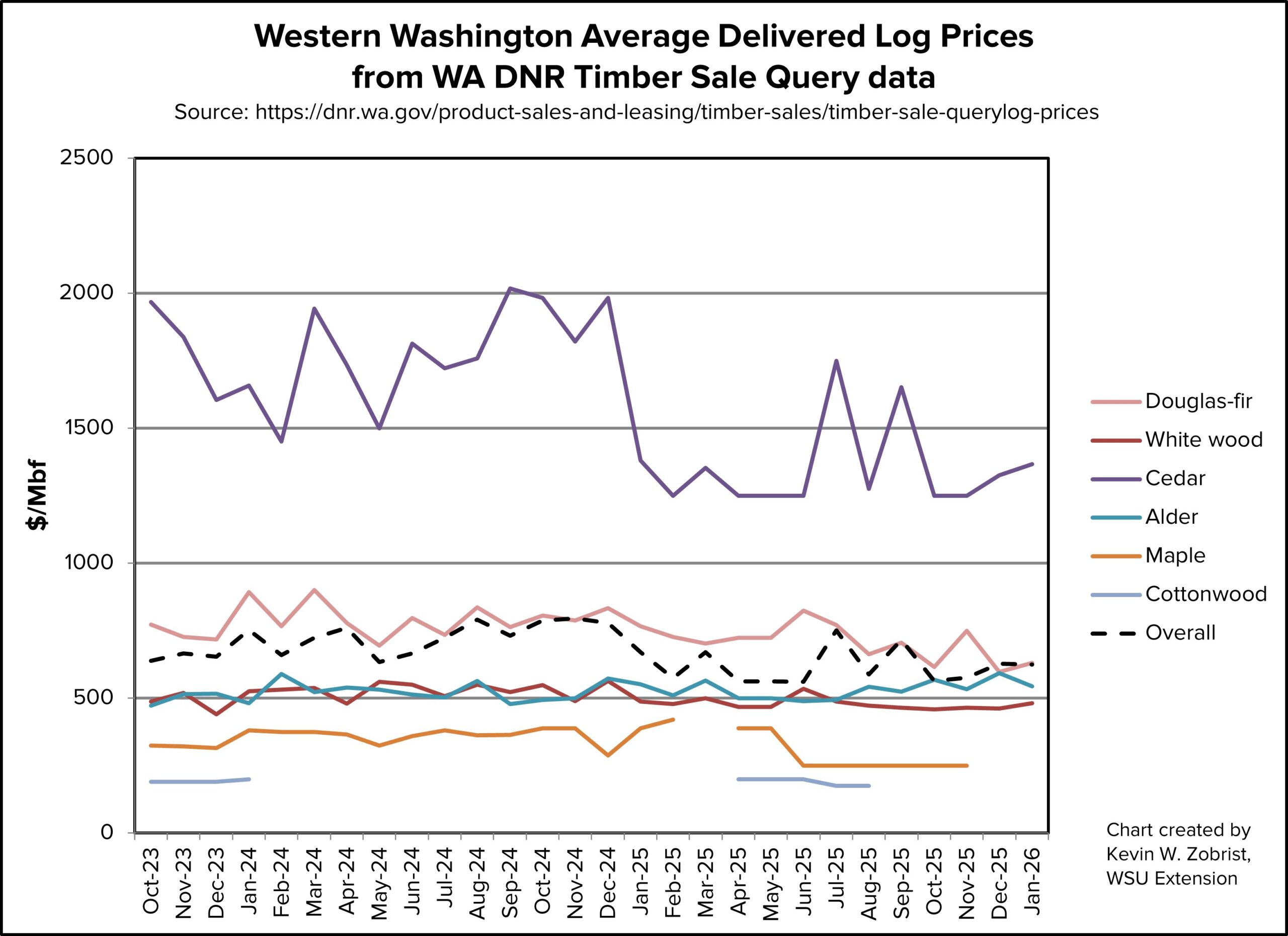
Here is the latest news on log prices in western Washington based on data provided by our friends at DNR in their monthly Timber Sale Query reports.
Market prices have been quite variable month to month but in general have declined a bit since late summer 2024. The average delivered log prices per thousand board feet (Mbf) in western Washington as of January 2026 were $1,367 for western redcedar, $631 for Douglas-fir, $544 for red alder, $482 for white woods (which include western hemlock and true firs), and $350 for bigleaf maple. The last price quote for black cottonwood was $175 in August 2025.
Focus on: native trees and shrubs for wet sites in western Washington
Trees for wet areas
Sun to part shade
- Black cottonwood (Populus trichocarpa)
- Black hawthorn (Crataegus douglasii)
- Cascara (Frangula purshiana)
- Pacific crabapple (Malus fusca)
- Pacific willow (Salix lasiandra)
- Red alder (Alnus rubra)
- Shore pine (Pinus contorta var. contorta)
- Sitka spruce (Picea sitchensis)
- Western hemlock (Tsuga heterophylla)
- Western redcedar (Thuja plicata)
Shade
- Cascara (Frangula purshiana)
- Western hemlock (Tsuga heterophylla)
- Western redcedar (Thuja plicata)
Shrubs for wet areas
Sun – part shade
- Bald hip rose (Rosa gymnocarpa)
- Black swamp gooseberry (Ribes lacustre)
- Black twinberry (Lonicera involucrate)
- Blackcap raspberry (Rubus leucodermis)
- Broadleaf cattail (Typha latifolia)
- Devil’s club (Oplopanax horridus)
- Hardhack (Spiraea douglasii)
- Highbush cranberry (Viburnum edule)
- Hooker’s willow (Salix hookeriana)
- Nootka rose (Rosa nutkana)
- Pacific ninebark (Physocarpus capitatus)
- Red-osier dogwood (Cornus sericea)
- Salmonberry (Rubus spectabilis)
- Sitka willow (Salix sitchensis)
- Slough sedge (Carex obnupta)
- Stink currant (Ribes bracteosum)
- Swamp rose (Rosa pisocarpa)
- Sweet gale (Myrica gale)
Shade
- Bald hip rose (Rosa gymnocarpa)
- Black swamp gooseberry (Ribes lacustre)
- Black twinberry (Lonicera involucrate)
- Blackcap raspberry (Rubus leucodermis)
- Devil’s club (Oplopanax horridus)
- Pacific ninebark (Physocarpus capitatus)
- Red-osier dogwood (Cornus sericea)
- Salmonberry (Rubus spectabilis)
- Stink currant (Ribes bracteosum)
- Swamp rose (Rosa pisocarpa)
- Tall Oregon grape (Mahonia aquifolium)
Wet area tree and shrub references and resources
- King County Northwest Native Plant Guide
- Plants of the Pacific Northwest Coast
- Washington Native Plant Society Native Plant Directory
Subscription and Contact Info
Manage your subscription
You are currently subscribed to the Washington State University Puget Sound Extension Forestry mailing list. You can unsubscribe or change your subscription options by visiting our newsletter website.
Contact info
Kevin W. Zobrist
Professor, Extension Forestry
Washington State University
kevin.zobrist@wsu.edu
Puget Sound Extension Forestry Website
Acknowledgements
The Washington State University Puget Sound Extension Forestry program is made possible in part by funding from Island County, King County, King Conservation District, Pierce County, San Juan County, San Juan Islands Conservation District, Snohomish Conservation District’s Rates and Charges Funding, Snohomish County Surface Water Management, and the Washington State Department of Natural Resources.
Extension programs and employment are available to all without discrimination. Evidence of noncompliance may be reported through your local Extension office.
E-Newsletter
Visit our newsletter page to get our award-winning newsletter by email view current and past issues.